
Deep Learning Development Services for Smarter AI Solutions
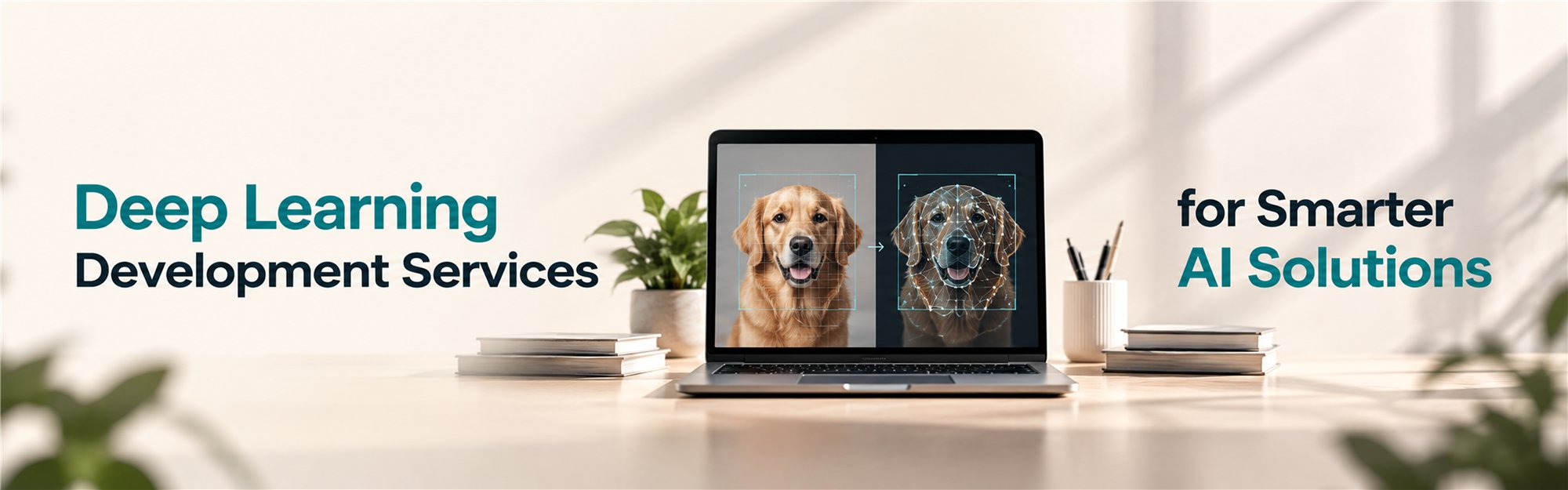
Businesses across industries are dealing with more data than ever before: customer behavior, images, transactions, sensor readings, and documents pile up faster than teams can manually review them. To make sense of this information and act on it quickly, many organizations are turning to artificial intelligence, and specifically to deep learning, a technology capable of recognizing patterns, understanding images, and making predictions with a level of nuance that older software methods struggled to achieve.
Deep learning sits behind many of the AI applications we interact with daily, from voice assistants to fraud detection systems to product recommendations. For business owners and technology leaders exploring how AI can support their operations, understanding what deep learning is, and what deep learning development services actually involve, is a useful starting point.
What Is Deep Learning?
Deep learning is a branch of machine learning that uses layered structures called neural networks to learn from data. Instead of being explicitly programmed with rules, a neural network is trained on large volumes of examples (images, text, numbers, or audio) and gradually learns to recognize patterns within that data.
Each layer in a neural network processes information a little differently, picking up on increasingly complex features. In an image recognition task, for instance, early layers might detect edges and shapes, while deeper layers learn to recognize objects, faces, or specific defects. This layered learning process is what allows deep neural networks to handle tasks that are difficult to define with fixed rules, such as understanding natural language or interpreting a photograph.
The strength of deep learning lies in its ability to improve as it's exposed to more data, making it well suited to problems involving images, video, speech, and other unstructured information.
How Deep Learning Development Services Help Businesses
Deep learning development services cover the full journey of building and deploying an AI model: not just writing code, but preparing the right data, training a model responsibly, and integrating it into existing business systems.
This typically includes:
- Data preparation: collecting, cleaning, and labeling data so it's usable for training
- Model development: selecting or designing a neural network architecture suited to the task
- Training and testing: teaching the model using historical data, then validating its performance on new examples
- Optimization: refining the model for accuracy, speed, and resource efficiency
- Deployment and integration: connecting the trained model to real business applications, whether that's a mobile app, a website, or an internal system
For a business without in-house AI expertise, working with a development partner that understands this full lifecycle can significantly reduce the risk of a project stalling midway or producing a model that doesn't hold up in real-world conditions.
The Role of Neural Network Development
Neural network development is the technical core of any deep learning project. Different problems call for different architectures. Convolutional neural networks (CNNs), for example, are commonly used for image-related tasks, while recurrent neural networks and transformer-based models are better suited to sequential data like text or time-series predictions.
Choosing the right architecture, and tuning it correctly, has a direct impact on how well a model performs. A neural network designed for classifying products in a retail catalog will look very different from one built to detect anomalies in financial transactions or transcribe audio into text. This is why neural network development often requires close collaboration between data scientists and the business teams who understand the problem being solved.
Computer Vision Development for Intelligent Applications
Among the most visible applications of deep learning is computer vision development, which enables machines to interpret and act on visual information. Rather than simply storing images, computer vision systems analyze them to detect objects, read text, recognize faces, or spot irregularities.
Practical uses of computer vision span a wide range of industries:
- Object detection in warehouses and retail environments for inventory tracking
- Quality inspection on manufacturing lines to catch defects before products ship
- Facial recognition for secure access control
- Medical imaging analysis to assist radiologists in spotting anomalies
- Retail analytics that track foot traffic and shelf activity
- Security monitoring through automated surveillance
- Autonomous systems, including vehicles and robotics, that rely on visual input to navigate
As cameras and sensors become more widespread, computer vision is increasingly seen as a practical way to automate visual tasks that would otherwise require constant human attention.
Deep Learning Model Training: From Data to Deployment
Deep learning model training is often the most resource-intensive part of building an AI solution, and getting it right matters as much as the model's design.
The process typically starts with gathering quality data that accurately represents the real-world scenarios the model will encounter. From there, the right model architecture is selected, and training begins: the model is exposed to labeled examples and gradually adjusts itself to minimize errors. This is followed by validation, where the model is tested against data it hasn't seen before, to check whether it generalizes well rather than simply memorizing the training set.
Performance evaluation, fine-tuning, and continuous improvement follow. Even after deployment, models often benefit from periodic retraining as new data becomes available, helping them stay accurate as conditions change. Skipping steps in this process, such as using insufficient data or failing to validate properly, is one of the most common reasons AI projects underperform.
Image Recognition Development and Its Applications
Image recognition development focuses specifically on teaching systems to identify and categorize visual content. This might mean recognizing a product on a shelf, identifying a specific type of vehicle, classifying medical scans, or detecting counterfeit items.
Businesses use image-based AI to automate tasks that would otherwise require manual visual review: checking whether a product meets quality standards, sorting images into categories, flagging inappropriate content, or analyzing patterns across thousands of photos. Because image recognition can process visual data far faster than manual inspection, it's often applied where speed and consistency matter, such as high-volume production lines or large digital catalogs.
The Value of Deep Learning Consulting
Not every business starts a deep learning project knowing exactly what it needs. This is where deep learning consulting plays a role, helping organizations figure out where AI can realistically add value before committing to full-scale development.
A consulting engagement typically involves identifying suitable use cases, evaluating whether existing data is sufficient for training, recommending appropriate technologies and architectures, and outlining a realistic implementation roadmap. This step is particularly useful for businesses that are AI-curious but unsure whether their data, infrastructure, or use case is actually a good fit for deep learning versus a simpler solution.
AI Deep Learning Solutions for Different Industries
AI deep learning solutions are being applied across a wide range of sectors, each with its own practical use cases:
- Healthcare: assisting with medical image analysis, patient data patterns, and diagnostic support tools.
- E-commerce: powering product recommendations, visual search, and customer behavior analysis.
- Manufacturing: enabling automated quality inspection and predictive maintenance on equipment.
- Banking and finance: supporting fraud detection and risk assessment through pattern recognition.
- Automotive: contributing to driver assistance systems and vehicle safety features.
- Retail: improving inventory management and in-store analytics.
- Logistics: optimizing route planning and warehouse automation.
- Security: strengthening surveillance systems with real-time anomaly detection.
- Agriculture: assisting with crop monitoring and detecting plant health issues through imagery.
While the specific application varies, the underlying goal across industries is similar: using data more effectively to make faster, more informed decisions.
How to Choose the Right Deep Learning Development Partner
Selecting a development partner is an important decision, and businesses generally benefit from evaluating a few key factors:
- Technical expertise across neural network architectures and AI frameworks
- Experience with AI and machine learning projects similar to your industry or use case
- Model development capabilities, including custom architecture design when needed
- Data security practices to protect sensitive business and customer information
- Customization: the ability to tailor solutions rather than offering one-size-fits-all models
- Scalability, so the solution can grow alongside business needs
- Integration capabilities with existing software, platforms, and workflows
- Testing and optimization processes to ensure reliable performance
- Post-development support for maintenance, retraining, and troubleshooting
Infotiqq is one example of a company businesses can consider when exploring customized deep learning and AI development requirements. Rather than offering fixed, generic models, Infotiqq focuses on understanding a business's specific data, goals, and technical environment before recommending an approach, an important distinction when the right AI solution often depends heavily on context.
Benefits of Deep Learning for Modern Businesses
When implemented thoughtfully, deep learning can offer several practical advantages:
- Intelligent automation of repetitive or visually demanding tasks
- Faster data analysis, reducing the time needed to extract insights
- Improved accuracy in classification and prediction tasks compared to manual review
- Better pattern recognition across large, complex datasets
- Automated image processing for visual inspection and analysis
- Predictive capabilities that support planning and risk management
- Personalized customer experiences based on behavior and preferences
- More efficient business processes, freeing up teams to focus on higher-value work
These benefits don't materialize automatically. They depend on quality data, thoughtful model design, and realistic expectations about what AI can and cannot do.
Conclusion
Deep learning, powered by neural networks, computer vision, careful model training, and image recognition, has become a practical tool for solving real business problems rather than a purely experimental technology. From automating visual inspections to supporting predictive analytics, its applications continue to expand across industries.
For businesses exploring how deep learning might fit into their own operations, Infotiqq works on developing customized AI solutions shaped around specific business requirements, technical environments, and long-term goals, recognizing that the right approach to AI development looks different for every organization.
Frequently Asked Questions
They encompass the full process of building an AI solution powered by neural networks, including data preparation, model development, training, testing, optimization, and deployment into real business applications.
It's the process of designing and building the layered computational structures that allow AI systems to learn patterns from data, with different architectures suited to different tasks like image analysis or text processing.
It refers to building AI systems capable of interpreting visual information, such as detecting objects, recognizing faces, or inspecting products for defects.
A model is trained by exposing it to large amounts of labeled data, allowing it to adjust internally to recognize patterns, followed by validation and optimization to ensure it performs reliably on new data.
It's a specific application of deep learning focused on identifying, classifying, and analyzing visual content, such as objects, products, or medical images.
Consulting is useful when a business is exploring AI possibilities but isn't sure which use cases are practical, what data is required, or how to plan an implementation strategy.
They're used across industries for tasks like fraud detection, medical image analysis, predictive maintenance, personalized recommendations, and automated visual inspection.
Look for technical expertise, relevant experience, strong data security practices, customization capability, scalability, integration support, and ongoing post-development assistance.




