
Docker Deployment Services: Simplifying Application Deployment with Containers
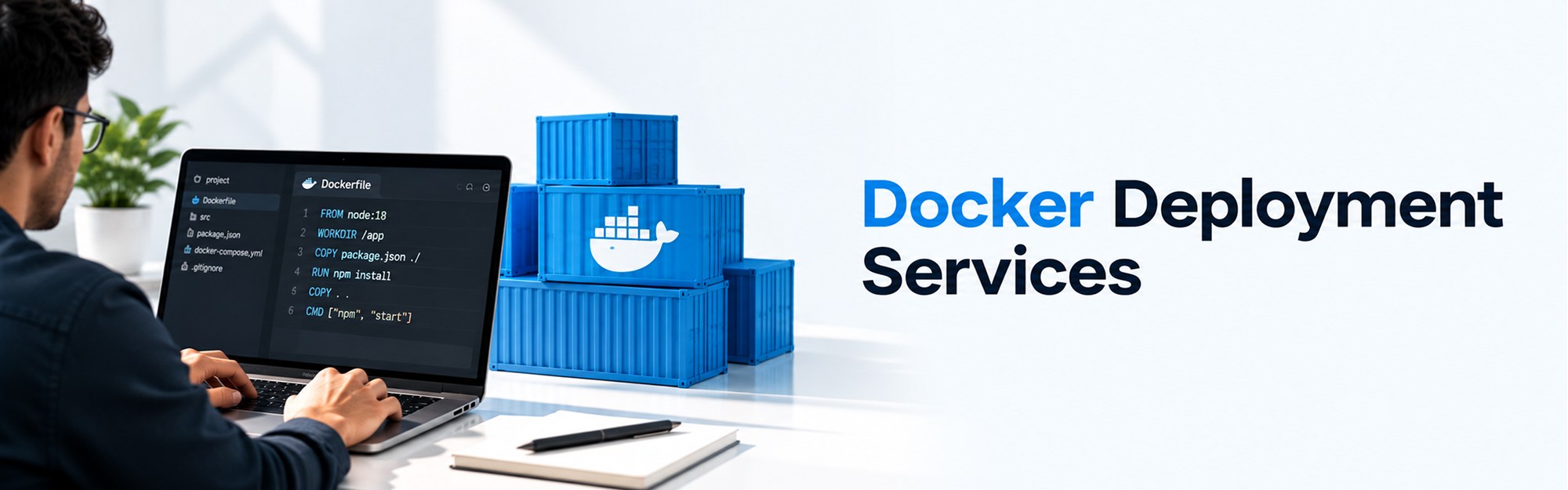
Anyone who's shipped software knows the feeling: an application works perfectly on a developer's laptop, then breaks the moment it hits a staging server or, worse, production. It's rare because the code is wrong. More often, it's a mismatch between a different library version, a missing environment variable, or an operating system quirk that nobody accounted for.
This gap between development and production environments has been a persistent headache for engineering teams. Add in dependency conflicts, manual deployment steps that are easy to get wrong, applications that struggle to scale under real traffic, and infrastructure that behaves differently across servers, and it's easy to see why deployment failures and unplanned downtime remain common problems even for experienced teams.
Docker addresses a good chunk of this by packaging an application together with everything it needs to run (code, libraries, configuration, runtime) into a single, portable unit called a container. That container behaves the same way whether it's running on a developer's machine, a test server, or a production cluster. It doesn't eliminate every deployment challenge, but it removes a large source of inconsistency.
Infotiqq works with businesses on Docker deployment services, containerization, and related consulting, helping teams move applications into containers and deploy them in a way that's repeatable and easier to manage. This article walks through what Docker actually does, why businesses adopt it, what professional Docker services typically involve, and what to think about when planning a container-based deployment strategy.
What Is Docker and How Does It Work?
Docker is a platform for building, packaging, and running applications inside containers. A container is a lightweight, isolated unit that bundles an application's code with the libraries, dependencies, and configuration it needs, so it runs consistently no matter where it's deployed.
A few core concepts are worth understanding:
- Docker images are the blueprint for a container, a read-only snapshot containing the application and everything it depends on.
- A Dockerfile is a simple text file with instructions for building that image: what base system to start from, what to install, what files to copy, and how to start the application.
- The Docker Engine is the software that builds images and runs containers based on them.
- Docker registries are where images are stored and shared, so a team can build an image once and deploy it consistently across multiple environments.
Containers differ from traditional virtual machines in an important way. A virtual machine includes a full operating system, which makes it heavier and slower to start. A container shares the host system's OS kernel and only packages what the application actually needs, making it far lighter and faster to spin up.
A simple way to picture this: imagine a small web application that depends on a specific version of Node.js, a couple of libraries, and a particular set of environment variables. Without Docker, getting that exact setup right on every server is a manual, error-prone process. With Docker, that entire configuration is captured in an image once, and any server that runs that image gets an identical environment with no guesswork, and no "it works on my machine" conversations.
Why Businesses Use Docker for Application Deployment
The appeal of Docker for most businesses comes down to a handful of practical benefits:
- Consistent environments: the same container runs the same way in development, staging, and production
- Faster deployment: containers start quickly compared to provisioning full servers or virtual machines
- Portability: a containerized application can move between cloud providers or on-premise infrastructure with minimal changes
- Better resource utilization: containers are lightweight, so more of them can run on the same hardware compared to full virtual machines
- Easier scaling: additional containers can be started to handle increased load
- Simplified dependency management: dependencies are packaged with the application rather than installed separately on each server
- Deployment automation: containers fit naturally into automated deployment pipelines
- Easier testing: developers can run the exact same environment locally that will run in production
- Support for modern DevOps workflows: containers are a foundational piece of most contemporary DevOps practices
These are genuine advantages, but it's worth being realistic: none of them are automatic. The actual gains a business sees depend on how the application is architected, how the containerization is implemented, what the workload looks like, and how the surrounding infrastructure is set up. Properly configured Docker services can meaningfully improve deployment reliability, but a poorly planned containerization effort can just as easily introduce new problems.
Docker Containerization Services: What Do They Include?
Moving an existing application into containers isn't always as simple as writing a Dockerfile and hoping for the best, especially for applications that weren't originally designed with containers in mind. This is typically where professional Docker containerization services come in.
A thorough containerization engagement generally covers:
- Assessing the existing application and its dependencies
- Planning the containerization approach based on that assessment
- Writing and refining Dockerfiles
- Building and testing Docker images
- Managing dependencies so the image stays lean and functional
- Configuring containers for the target environment
- Setting up Docker Compose for applications with multiple interconnected services
- Configuring environment-specific settings
- Addressing container security considerations, such as minimizing image size and avoiding unnecessary privileges
- Optimizing images for faster builds and smaller footprints
- Integrating with a container registry for image storage and versioning
- Testing the containerized application before deployment
- Documenting the setup and supporting ongoing maintenance
Businesses often benefit from professional help here simply because containerizing a legacy application, with tangled dependencies, hardcoded configurations, or unusual runtime requirements, takes a different kind of expertise than building a new application in containers from scratch.
Docker Deployment Services for Modern Applications
Once an application is containerized, actually deploying it reliably is its own undertaking. Docker deployment services typically cover:
- Application containerization as a starting point
- Preparing the target deployment environment
- Managing Docker images across versions
- Configuration management across different environments
- Handling environment variables securely
- Networking between containers and external systems
- Persistent storage for data that needs to survive container restarts
- Container monitoring for health and performance
- Deployment automation
- Integration with CI/CD pipelines
- Support for both cloud and on-premise deployment
- Managing application updates and version rollouts
It's worth emphasizing that deployment is not just "create a container and run it." A production-ready deployment needs a real plan for application architecture, networking, storage, security, and monitoring, along with an operational process for handling updates and incidents. Skipping this planning is one of the more common reasons containerized applications underperform in production despite working fine in testing.
Docker-Based Application Deployment: From Development to Production
Docker-based application deployment generally follows a consistent sequence, even though the specifics vary by application:
- Assess the application: understand its architecture, dependencies, and requirements
- Identify dependencies: libraries, runtimes, and services the application relies on
- Create the Dockerfile: define how the image should be built
- Build and test the Docker image: verify it behaves as expected
- Store the image in a container registry: making it available for deployment
- Configure the deployment environment: servers, cloud resources, or clusters
- Deploy the container: run it in the target environment
- Configure networking and storage: so the application can communicate and persist data correctly
- Integrate monitoring and logging: to track health and catch issues early
- Establish an update and maintenance process: for ongoing versions and patches
Following this kind of structured flow, rather than treating each step as an afterthought, is usually what separates a smooth containerization project from one that runs into repeated issues after launch.
Docker and CI/CD: Automating Application Delivery
Docker fits naturally into CI/CD (continuous integration and continuous delivery) pipelines, which automate much of the process of getting code from a developer's commit into production.
A typical containerized CI/CD workflow might look like:
- A developer commits code changes
- Automated tests run against the code
- A Docker image is built from the updated code
- The image is scanned for known vulnerabilities
- The image is stored in a registry
- The image is deployed to a staging environment for further testing
- Once approved, the same image is deployed to production
- Monitoring tracks the application's behavior post-deployment
Tools like GitHub Actions, GitLab CI/CD, and Jenkins are commonly used to orchestrate workflows like this, mentioned here simply as examples of the kind of tooling involved, not as a reflection of any specific platform Infotiqq uses for a given project. The real value of combining Docker with CI/CD is repeatability: because the same image moves through every stage, teams can be far more confident that what passed testing is exactly what's running in production.
Docker Services for Cloud Applications
Docker and cloud infrastructure tend to work well together. Containers are portable by design, which makes them a natural fit for cloud environments where workloads may need to scale up or move between resources.
Relevant considerations include:
- Deploying containers on cloud infrastructure
- Maintaining application portability across cloud providers
- Scaling containerized workloads based on demand
- Managing cloud storage and networking for containers
- Using container registries hosted in the cloud
- Integrating containers into cloud-based CI/CD pipelines
- Using Kubernetes as an orchestration layer for larger, more complex environments
It's worth being clear that Docker and Kubernetes are not the same thing and shouldn't be treated interchangeably. Docker handles building and running individual containers. Kubernetes is an orchestration platform that manages many containers across multiple servers, handling scaling, failover, and scheduling. Many businesses start with Docker alone and only introduce Kubernetes once their containerized environment grows complex enough to need that level of coordination.
When Should a Business Consider Docker Consulting?
Professional guidance tends to be particularly useful in situations such as:
- Migrating legacy applications that weren't built with containers in mind
- Modernizing outdated application infrastructure
- Moving applications toward cloud-based environments
- Reducing inconsistencies between development and production
- Building standardized, container-based development environments
- Creating CI/CD pipelines around containerized applications
- Improving existing deployment processes that have become unreliable
- Preparing an application for orchestration tools like Kubernetes
- Establishing container security and lifecycle management practices
For businesses evaluating a Docker consulting company India, it's worth looking past general claims and focusing on concrete factors: technical expertise with Docker and related tooling, a clear understanding of the business's existing infrastructure, sound security practices, clear communication throughout the project, proper documentation, and a willingness to support the environment after initial deployment, not just get it live and move on.
Docker Deployment for Different Types of Applications
Docker's flexibility means it suits a wide range of application types:
- Web applications: consistent hosting across environments
- APIs: isolated, independently deployable services
- Microservices: individual services packaged and deployed separately
- Backend systems: including databases and processing services (with appropriate persistent storage)
- Development environments: standardized setups for entire engineering teams
- Testing environments: quick, disposable environments for QA
- Data-processing applications: batch or scheduled jobs that need isolated, repeatable execution
A microservices-based e-commerce platform, for instance, might run its product catalog, checkout process, and recommendation engine as separate containers, each independently deployable and scalable, rather than bundled into one large, harder-to-manage application.
Common Docker Deployment Challenges
Docker solves real problems, but it introduces its own set of considerations that need proper planning:
- Container security: misconfigured containers or excessive privileges can create risk
- Image vulnerabilities: outdated base images can carry known security issues
- Improper resource allocation: containers without proper limits can compete for server resources
- Networking complexity: communication between containers and external systems needs careful design
- Persistent data management: containers are often short-lived, so data that needs to persist requires a deliberate storage strategy
- Logging and monitoring: without it, diagnosing issues across many containers becomes difficult
- Configuration management: keeping settings consistent and secure across environments
- Container lifecycle management: knowing when to update, replace, or retire containers
- Scaling: adding containers effectively as demand grows
- Environment differences: development and production still need to be kept genuinely aligned
None of these are reasons to avoid Docker; they're simply areas that need real architectural planning and ongoing operational attention rather than a one-time setup.
Docker Services by Infotiqq
Infotiqq provides Docker-related services covering the areas discussed throughout this article, including Docker containerization, Docker deployment services, Docker-based application deployment, Docker environment setup, deployment automation, Docker consulting, application modernization, and integration with cloud and DevOps workflows.
The approach is centered on understanding what a specific application actually needs (its architecture, dependencies, and operational requirements) rather than applying a generic containerization template to every project.
How to Choose the Right Docker Service Provider
When evaluating a Docker service provider, useful factors to consider include:
- Hands-on experience with Docker and containerization
- Understanding of application architecture, not just container mechanics
- Familiarity with cloud platforms and DevOps practices
- Awareness of container security practices
- Experience integrating Docker into CI/CD pipelines
- Monitoring and troubleshooting capabilities
- Clear, consistent communication
- Proper documentation of what's built
- Availability for ongoing maintenance and support
- Genuine understanding of the business's specific requirements
Location or a generic "we do Docker" label isn't a reliable indicator of fit. What matters more is whether the provider understands the project's specific technical context and can support it beyond the initial deployment.
Future of Containerized Application Deployment
Containerization continues to be a foundational part of how modern applications are built and deployed. It underpins microservices architectures, works alongside orchestration platforms like Kubernetes, and increasingly intersects with serverless container platforms that abstract away even more infrastructure management.
Cloud-native application development, DevSecOps practices that build security into the development pipeline, and broader infrastructure automation are all areas where containers play a central role. This isn't a prediction so much as a reflection of where deployment practices already stand: containers have become a standard building block rather than an emerging trend.
Conclusion
Docker gives businesses a practical way to package applications consistently, deploy them more reliably, and manage them with far less environment-related guesswork than traditional deployment approaches. But the benefits aren't automatic; they depend on proper containerization, thoughtful architecture, attention to security, a solid deployment process, and ongoing management once the application is live.
Infotiqq provides Docker deployment, containerization, and consulting services for businesses working through these decisions, from initial application assessment through to production deployment and maintenance. If your team is dealing with inconsistent environments, manual deployment headaches, or an application that's ready to move toward containers, it's worth taking stock of your current setup and exploring whether a Docker-based approach fits your specific requirements.
Frequently Asked Questions
Docker deployment services involve packaging an application into containers and deploying it across development, staging, and production environments in a consistent, repeatable way.
Docker containerization services cover the process of assessing an application, building Docker images, configuring containers, and preparing an application to run reliably inside containers.
Docker-based application deployment typically follows a sequence: assessing the application, building a Docker image, testing it, storing it in a registry, and deploying it to the target environment with proper networking, storage, and monitoring in place.
Docker containers help ensure applications run consistently across different environments, reduce dependency conflicts, and support faster, more automated deployment processes.
Docker containers share the host operating system's kernel and only package what the application needs, making them lighter and faster than virtual machines, which each include a full separate operating system.
Yes. Docker containers are portable by design, making them well-suited for deployment across cloud platforms, and they integrate naturally with cloud-based CI/CD pipelines.
Businesses typically benefit from a Docker consulting company India when migrating legacy applications, modernizing infrastructure, building CI/CD pipelines, or preparing applications for container orchestration.
Yes. Docker images can be built, tested, and deployed automatically as part of a CI/CD pipeline, making application delivery more consistent and repeatable.
Docker can support web applications, APIs, microservices, backend systems, development and testing environments, and data-processing applications.
Infotiqq provides Docker deployment services, containerization, consulting, and ongoing support to help businesses move applications into containers and deploy them reliably.




