
Python Web Development: Turning Business Ideas into Digital Solutions
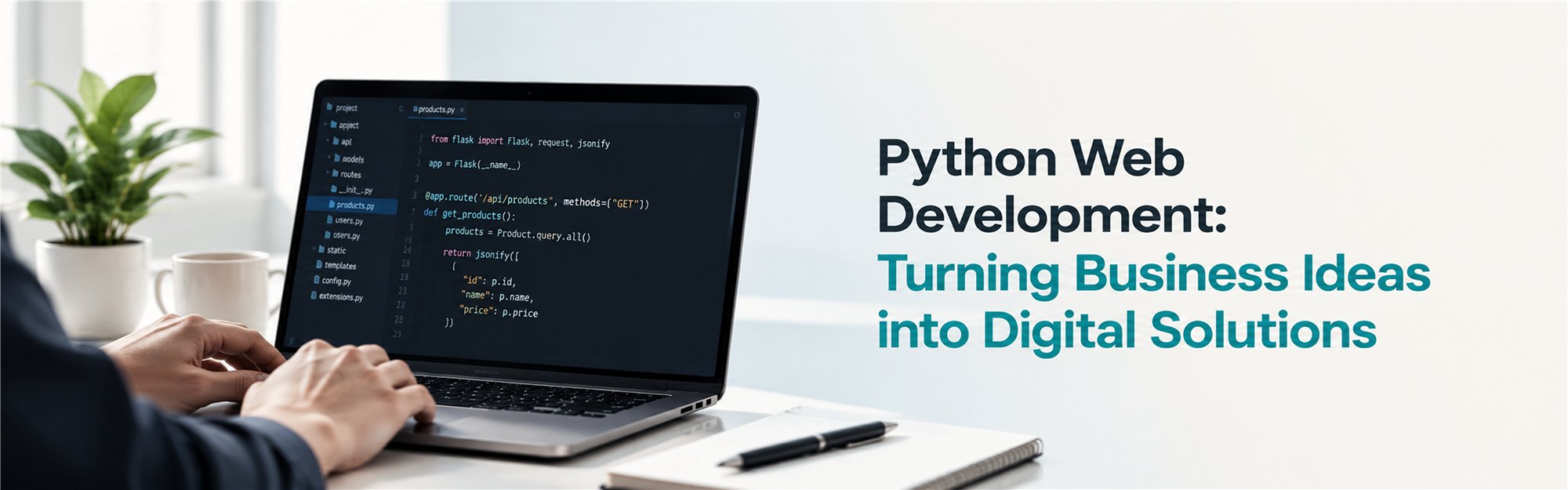
Every business eventually reaches a point where an idea needs to become a working digital product: a customer portal, an internal tool, an eCommerce platform, or a full-scale SaaS application.
The hard part is rarely the idea itself. It's finding a technology foundation that can handle growth, connect cleanly with existing systems, and stay maintainable as requirements shift. This is one of the reasons Python web development has earned a solid reputation among startups, established enterprises, and technology teams alike.
Python's readability, mature ecosystem, and active community support make it a practical choice for applications meant to evolve over time rather than be rebuilt every few years. This article walks through what Python web development actually involves, why businesses lean on it, and how to evaluate a Python development company for your next project.
What Is Python Web Development?
Python web development refers to building web applications, APIs, and backend systems using the Python programming language, typically alongside one of its established frameworks. Two frameworks dominate this space:
- Django: a full-featured framework with built-in tools for authentication, database management, admin interfaces, and security. It tends to be the pick for applications that need a lot of functionality out of the box.
- Flask: a lightweight, flexible framework better suited to smaller applications, microservices, or projects where developers want more control over individual components.
Both frameworks are backed by large communities and extensive libraries, which means common problems like user authentication, payment processing, and file handling rarely need to be solved from scratch. That's one of the quieter advantages of Python: a lot of the groundwork already exists, tested and documented, so development time goes toward the features that actually differentiate a business rather than reinventing infrastructure.
What Do Python Web Development Services Include?
When businesses talk about Python web development services, they're usually referring to a broad set of capabilities rather than a single deliverable. A typical engagement can include:
- Custom web application development tailored to specific business workflows
- Backend development, including server-side logic, data processing, and business rules
- API development for connecting mobile apps, third-party services, or internal systems
- Database integration, whether relational (PostgreSQL, MySQL) or non-relational (MongoDB)
- Third-party integrations with payment gateways, CRMs, shipping providers, or analytics tools
- Application migration, moving legacy systems onto more modern, maintainable architecture
- Testing and quality assurance to catch issues before they reach production
- Ongoing maintenance and performance optimization as usage grows
Depending on the project, a team might handle all of these end-to-end, or focus on a specific piece, such as building an API layer for a mobile app that already has a frontend team in place.
Why Businesses Choose Python for Web Development
There are several practical reasons Python web development continues to be a popular choice for business applications, beyond just the language's general popularity.
- Readability and maintainability. Python's syntax is deliberately simple, which makes code easier for teams to read, review, and hand off. This matters more than it sounds: a business application often outlives its original developers, and code that's easy to understand is code that's cheaper to maintain.
- Flexibility across project types. Python isn't tied to one kind of application. The same language that powers a content-heavy website can also handle data pipelines, machine learning features, or automation scripts, which is useful for businesses that expect their platform to grow in directions they haven't fully mapped out yet.
- Strong integration capabilities. Python has libraries for nearly every common integration need: payment processors, cloud storage, messaging services, and analytics platforms. This reduces the custom engineering required to connect a new application to the tools a business already relies on.
- Scalability. No language is automatically scalable, but Python applications built with sound architecture (proper caching, asynchronous processing, load balancing) can handle significant traffic. Some of the internet's larger platforms run parts of their infrastructure on Python, which speaks to its ability to support high-traffic systems when engineered correctly.
- A large talent pool and active ecosystem. Because Python is widely taught and used across industries, businesses generally have an easier time finding developers to maintain or extend an existing Python codebase compared with more niche technologies.
Types of Applications You Can Build With Python
Python web development supports a wide range of application types, including:
- Business web applications and internal tools
- eCommerce platforms
- SaaS products and subscription-based services
- Customer portals and self-service dashboards
- Content management systems
- Booking and scheduling platforms
- Data-driven applications with reporting or analytics features
- API-based applications that serve mobile apps or third-party integrations
This range is part of why Python remains relevant across industries: a fintech startup, a healthcare provider, and a logistics company can all use the same underlying technology, just configured differently for their specific needs.
When to Work With a Python Development Company
Simple websites or prototypes can sometimes be built by a small internal team or even a single developer. But as requirements grow (more users, more integrations, stricter security needs, more complex business logic), the value of working with an established Python development company becomes clearer.
A dedicated development team typically brings structured experience in:
- Architecture planning, so the application is built to handle future growth rather than needing a rewrite in a year
- Security practices, including proper authentication, data encryption, and protection against common vulnerabilities
- Integration expertise, connecting new systems with existing CRMs, ERPs, or payment platforms without disrupting current operations
- Testing processes, catching bugs and performance issues before they affect real users
- Ongoing support, since most applications need updates, patches, and improvements well after the initial launch
For complex or customer-facing projects, this structured approach often saves more time and cost in the long run than trying to manage development piecemeal.
Choosing a Python Development Company in India
India has become a significant hub for software development, including Python web development, thanks to a combination of technical talent and cost-effective delivery. When evaluating a Python development company in India, businesses should look at a few specific factors rather than relying on general reputation alone:
- Python and framework expertise: direct experience with Django, Flask, or other relevant frameworks
- Relevant project experience: has the company built applications similar in scope or industry to yours?
- Custom development capabilities: can they build tailored functionality, not just work from templates?
- API and database expertise: experience designing efficient, secure data structures and integrations
- Security practices: clear processes for handling sensitive data and preventing vulnerabilities
- Communication: responsiveness and clarity, especially important for teams working across time zones
- Project management approach: whether they follow structured methodologies like Agile or Scrum
- Scalability planning: whether the proposed architecture can grow with your business
- Maintenance and support: what happens after launch, and how issues are handled
These factors matter more than pricing alone, since the cheapest option often ends up costing more in rework or missed deadlines.
How Infotiqq Approaches Python Development
Infotiqq approaches Python projects by starting with a clear understanding of business requirements before any code is written. This typically involves discussing the problem the application needs to solve, the users who will interact with it, and any systems it needs to connect with.
From there, the process generally moves through solution architecture planning, custom feature development, integration with third-party systems where needed, structured testing, deployment, and post-launch support. Rather than applying a one-size-fits-all template, the goal is to match the technical approach to the specific business context: a customer-facing SaaS product and an internal reporting tool call for different priorities, even if both are built in Python.
This kind of structured, requirements-first process is fairly standard among established teams offering Python web development services, and it's worth asking any potential partner how their own process compares.
How to Choose the Right Python Web Development Partner
Before committing to a development partner, it helps to run through a practical checklist:
- Does the team have demonstrated technical expertise in Python and relevant frameworks?
- Do they have framework experience matching your project's needs (Django for feature-rich apps, Flask for lighter services)?
- Can they show a project portfolio with applications similar in complexity to yours?
- Are they capable of true customization, rather than adapting a generic template?
- What security measures do they follow by default?
- How do they plan for scalability as your user base grows?
- Is their communication clear and consistent throughout the project?
- What development methodology do they follow, and how do they handle changing requirements?
- How thorough is their testing process before deployment?
- Do they provide clear documentation for future developers or internal teams?
- What does post-launch support actually include, and for how long?
Going through these questions with any prospective partner, including Infotiqq, helps set realistic expectations before development begins.
Conclusion
Python web development offers businesses a practical path from an early-stage idea to a fully functioning, scalable application. Its readability, flexibility across project types, and strong integration capabilities make it well-suited for everything from small internal tools to large customer-facing platforms.
The technology itself, however, is only part of the equation. The right Python development company brings the architecture planning, security practices, and ongoing support needed to keep an application reliable as it grows. Whether you're exploring Python web development services for the first time or looking to migrate an existing system, Infotiqq can help translate your specific business requirements into a well-structured, maintainable application.
Frequently Asked Questions
Python web development is the process of building web applications, APIs, and backend systems using Python, typically with a framework such as Django or Flask.
These services generally include custom application development, backend and API development, database integration, third-party integrations, migration, testing, and ongoing maintenance.
Python offers readable, maintainable code, strong integration options, and the flexibility to support a wide range of application types as a business grows.
Python can be used to build business applications, eCommerce platforms, SaaS products, customer portals, content management systems, booking systems, and data-driven applications.
Look for demonstrated framework expertise, relevant project experience, strong security practices, clear communication, and a defined process for testing and post-launch support.
Beyond cost-effectiveness, evaluate technical expertise, portfolio relevance, communication practices across time zones, and their approach to scalability and long-term support.
Costs vary widely based on application complexity, required integrations, and ongoing support needs; a detailed scope discussion with a development partner is the most reliable way to get an accurate estimate.
Timelines depend on the application's scope; a simple tool might take a few weeks, while a complex, feature-rich platform can take several months from planning through deployment.




